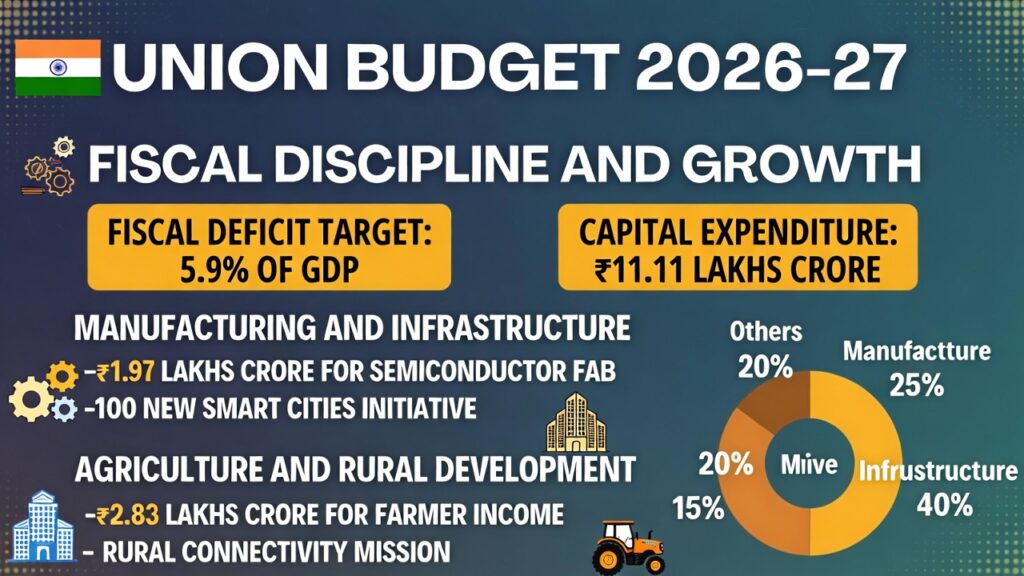
The Union Budget 2026-27, presented by Finance Minister Nirmala Sitharaman on February 1, 2026, is her ninth consecutive budget. This makes it a record-setting presentation in recent times. The budget focuses on long-term growth, youth empowerment, manufacturing strength, infrastructure development, and inclusive progress under the vision of Viksit Bharat.
The total budget size stands at around ₹53.5 lakh crore. The government aims for a fiscal deficit of 4.3% of GDP (down slightly from 4.4% in the previous year). Capital expenditure (capex) has been hiked to ₹12.2 lakh crore, up 9% from ₹11.2 lakh crore earlier. This push on infrastructure and manufacturing is expected to create jobs and boost economic resilience amid global challenges.
Fiscal Overview at a Glance
- Total Expenditure → ₹53.5 lakh crore (approx.)
- Net Tax Receipts → ₹28.7 lakh crore
- Capital Expenditure → ₹12.2 lakh crore (highest ever, ~4.4% of GDP)
- Fiscal Deficit → 4.3% of GDP
- Revenue Deficit → Around 1.5% of GDP
- Gross Market Borrowings → Around ₹17.2 lakh crore
The budget balances fiscal discipline with investments in people, farms, and industries. It avoids heavy populist measures and focuses on sustainable reforms.
Major Themes and Engines of Growth
The budget outlines three key duties (kartavyas):
- Accelerating sustainable economic growth
- Building capacities for people’s aspirations
- Inclusive development for all (Sabka Saath, Sabka Vikas)
It identifies four engines:
- Agriculture – First engine
- MSMEs – Second engine
- Investment – Third engine
- Exports – Fourth engine
Key Sector-Wise Highlights
1. Manufacturing and Industry Push
A big focus is on making India a global manufacturing hub. Key announcements include:
- Launch of ISM 2.0 (Integrated Semiconductor Mission) to strengthen chip production and supply chains.
- Electronics Components Manufacturing Scheme outlay increased to ₹40,000 crore.
- Rare earth corridors in Odisha, Kerala, Andhra Pradesh, and Tamil Nadu.
- Chemical parks on plug-and-play model in states.
- Biopharma Shakti initiative with ₹10,000 crore over 5 years for biologics and biosimilars.
- Revival packages for legacy sectors like textiles and leather.
- ₹10,000 crore SME Growth Fund to help MSMEs scale up with equity and debt support.
- Special concessions for SEZ units to sell in domestic market.
These steps aim to raise manufacturing’s GDP share and create skilled jobs.
2. Infrastructure Development
Infrastructure gets the largest capex boost:
- ₹12.2 lakh crore total capex.
- Seven high-speed rail corridors: Mumbai-Pune, Pune-Hyderabad, Hyderabad-Bengaluru, Hyderabad-Chennai, Chennai-Bengaluru, Delhi-Varanasi, Varanasi-Siliguri.
- New Dedicated Freight Corridor (Dankuni to Surat).
- 20 new National Waterways, starting with NW-5 in Odisha.
- Coastal Cargo Promotion Scheme to raise inland waterways share to 12% by 2047.
- City Economic Regions (CERs) – ₹5,000 crore each for select cities over 5 years.
- Incentives for seaplane manufacturing and aviation connectivity.
- ₹10,000 crore for container manufacturing.
Lower logistics costs (from current 14% of GDP) and better connectivity are expected to support exports and growth.
3. Agriculture and Rural Focus
- Allocation: Around ₹1.62 lakh crore (up 7%).
- Prime Minister Dhan-Dhaanya Krishi Yojana for low-productivity districts.
- Mission for self-reliance in pulses (Tur, Urad, Masoor).
- AI tools for farmers on weather, markets, and practices.
- Support for high-yield seeds, cotton productivity, and organic farming.
These aim to raise farmer incomes and build rural resilience.
4. Health, Education, and Skilling
- Duty exemptions on 17 cancer drugs and lifesaving medicines.
- Three new All India Institutes of Ayurveda.
- AVGC labs in 15,000 schools and 500 colleges.
- Girls’ hostels in higher education institutions.
- Skilling for 10,000 tourist guides.
- Expansion of medical seats and day-care cancer centres in districts.
Focus on youth (Yuva Shakti) through education and jobs in creative sectors.
5. Defence and Security
- Defence allocation up significantly (around ₹5.9 lakh crore in some reports, with modernization focus).
- Ministry of Home Affairs: Over ₹2.55 lakh crore (up 9.44%).
- Emphasis on indigenization and border security.
6. Tax Changes – Direct and Indirect
Direct Taxes
- No change in income tax slabs (status quo after last year’s reforms).
- New Income Tax Act, 2025 effective from April 2026 – simplifies rules (sections reduced).
- STT hike: Futures to 0.05% (from 0.02%), Options to 0.15% (from 0.1%).
- Buybacks taxed as capital gains.
Indirect Taxes
- Customs duty exemptions on lithium-ion cells, critical minerals, battery goods.
- 50% cut in customs duty on personal imports (from 20% to 10%).
- Tax holiday for foreign cloud providers till 2047.
- GST tweaks: Simplified post-sale discounts, changes in intermediary services.
These aim to ease business, reduce costs for essentials, and promote domestic production.
Quick Comparison Table: Key Allocations (Approximate)
| Sector/Ministry | Allocation (₹ lakh crore) | Key Focus |
|---|---|---|
| Finance (including interest) | ~19.72 | Largest share, subsidies, transfers |
| Defence | ~7.85 | Modernization, indigenization |
| Home Affairs | ~2.55 | Internal security |
| Capital Expenditure (Total) | 12.2 | Infrastructure push |
| Agriculture & Allied | ~1.62 | Farmer welfare, pulses mission |
| Electronics/Semicon | Schemes up to 0.4 | ISM 2.0, components |
Overall Impact and Expectations
This budget continues the reform path – more capex, manufacturing incentives, and tax simplification. It targets job creation for youth, better rural incomes, and global competitiveness. While no big tax relief for middle class came (slabs unchanged), procedural ease and sector boosts should help.
Challenges remain: Execution of big projects, private investment revival, and global risks like trade tensions. But the focus on sustainability, inclusion, and tech (AI, semiconductors) positions India well for long-term growth.
Experts call it a balanced, forward-looking plan. As the FM said, it’s about “action over ambivalence, reform over rhetoric.” For common people, cheaper medicines and better connectivity could bring real benefits. For businesses, incentives in manufacturing and exports open new doors.